

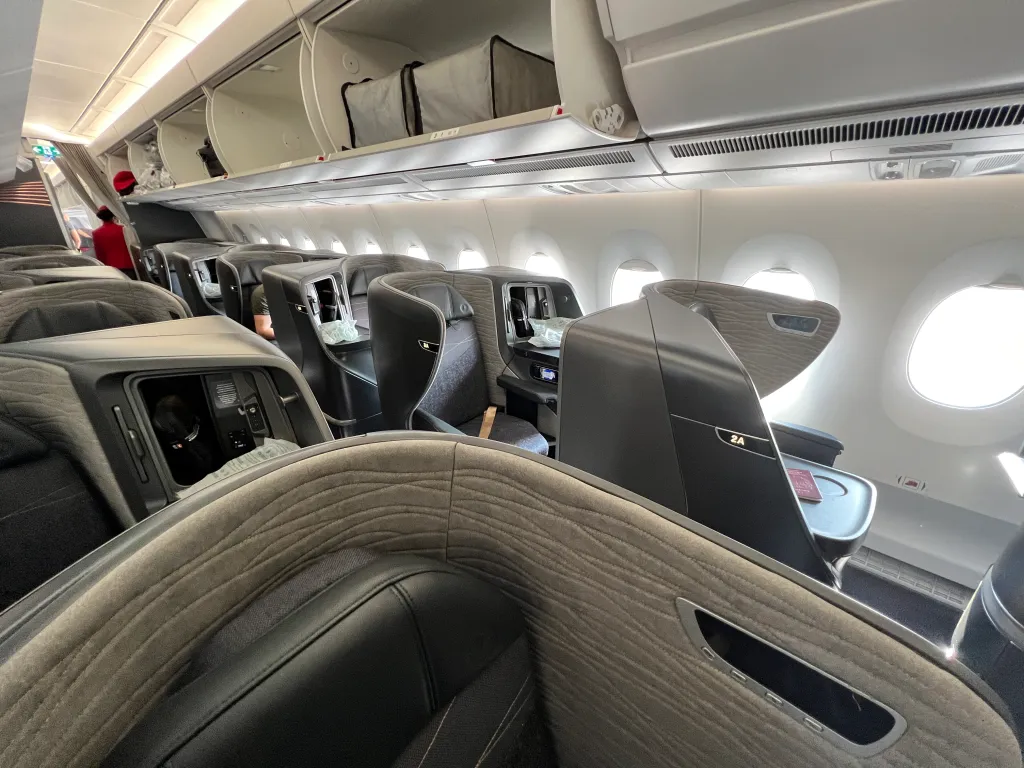
Business class has a reputation for being the exclusive preserve of corporate expense accounts and the genuinely wealthy. The price tags on published fares seem to confirm this — $4,000 from London to Dubai, $7,000 from New York to Singapore, $9,000 from Sydney to Paris. Glance at those numbers and it’s easy to conclude that a lie-flat bed and a decent Champagne service are simply out of reach for most leisure travelers.
That conclusion is wrong. Business class is more accessible than the rack rates suggest, and the travelers who fly it regularly — on leisure budgets — are doing so through a combination of points strategy, booking timing, fare class knowledge, and a few techniques that the airlines don’t actively advertise. None of it is complicated. All of it is learnable. The Passport Stamper
This guide covers every practical method for booking business class for less in 2026 — from the fundamentals of points and miles to promotional fares, positioning flights, credit card strategies, and which airlines offer the best value at the premium end of the market.
Why Business Class Is More Accessible Than You Think
Before the tactics, some context. Airlines price business class dynamically — the same seat on the same flight can sell for dramatically different amounts depending on how far in advance you book, how full the cabin is, whether a promotional sale is running, and which booking channel you use. The $7,000 fare and the $2,800 fare can coexist on the same flight for weeks at a time.
More importantly, a significant proportion of business class seats are never sold for cash at all — they’re redeemed using frequent flyer points, upgraded from economy using miles or money, or offered to staff and partners. The airlines have built their pricing models around the assumption that a meaningful share of their premium cabin will be filled by non-cash passengers. This creates the opportunity for points redemptions that represent extraordinary value — and for cash fares that are far lower than the headline prices suggest.
The techniques below work. They require some planning and some flexibility, but none require insider connections or extraordinary luck.
1. Master the Points and Miles Game
Frequent flyer points remain the single most powerful tool for accessing business class at a fraction of the cash price. A business class seat that sells for $5,000 might be redeemable for 70,000 to 90,000 miles — miles that can be accumulated through credit card sign-up bonuses, everyday spending, and strategic transfers between programs.
The sign-up bonus is where the value concentrates. Premium travel credit cards in the US, UK, and Australia routinely offer sign-up bonuses of 50,000 to 150,000 points upon meeting a minimum spending requirement in the first few months. A single sign-up bonus, properly deployed, can fund a business class redemption on one of the world’s finest airlines. The key is choosing the right card for the right program.
The most valuable currencies for business class redemptions in 2026:
British Airways Avios is the most flexible currency for OneWorld partner redemptions — and Qatar Airways, with its QSuites product, is part of OneWorld. Booking Qatar Airways QSuites using British Airways Avios offers some of the best value in long-haul points travel, particularly on shorter routes where the distance-based pricing works in your favor. Our Qatar Airways Business Class vs Emirates Business Class comparison covers in detail why Qatar’s QSuites represent the top tier of what points can buy.
American AAdvantage miles are particularly strong for booking Cathay Pacific, British Airways, and Qatar Airways. Alaska Airlines Mileage Plan has historically offered exceptional value for Emirates and Cathay Pacific redemptions and remains one of the most underrated programs in North America.
Singapore KrisFlyer miles work well for Star Alliance partners and for Singapore Airlines own metal — one of the finest business class products in the sky. Chase Ultimate Rewards, American Express Membership Rewards, and Capital One Miles are transferable currencies that feed into multiple airline programs, giving you flexibility to wait and see which program has availability before committing.
The critical rule: accumulate transferable points where possible — hotel points and bank points that can be moved to multiple airline programs — rather than accruing directly with a single airline. Flexibility in where you deploy your points is more valuable than slightly higher earn rates in a single currency.
2. Book Far in Advance — or Very Last Minute
Business class pricing follows a pattern that rewards both ends of the booking window.
Far in advance (six to eleven months out) is when airlines release the most award availability and the lowest promotional cash fares. The premium cabin is still empty, the airline wants to generate revenue and fill award seats, and competition for specific dates hasn’t yet driven prices up. For peak travel periods — Christmas, summer, spring break — this window is the only reliable way to secure the seat you want at the price you want.
Very last minute (within two to three weeks of departure) occasionally produces the opposite phenomenon — airlines drop business class fares aggressively to fill seats that would otherwise fly empty. This is less predictable and requires genuine flexibility on dates and routing, but travelers with open schedules can find extraordinary deals in this window. Setting up fare alerts through Google Flights, Kayak, or dedicated deal services like Secret Flying and Jack’s Flight Club is the most reliable way to catch these drops.
The window to avoid is the middle — roughly three to five months before departure — where prices are typically at their highest for cash fares, and award availability has often been taken by earlier bookers.
3. Use Mistake Fares and Flash Sales
Mistake fares — pricing errors by airlines or booking systems that result in business class being sold at economy or premium economy prices — are less common than they were a decade ago, but they still occur several times a year and they still represent extraordinary value when you catch one.
The key to catching mistake fares is speed and the right information sources. Several communities and newsletters specialize in alerting subscribers to error fares as soon as they appear — Secret Flying, The Flight Deal, and Airfarewatchdog in the US; HolidayPirates and Jack’s Flight Club in Europe. Following these closely and booking immediately when a deal appears (before the airline corrects the error) is the only reliable strategy.
Flash sales are more predictable. Emirates, Qatar Airways, Turkish Airlines, Singapore Airlines, and Cathay Pacific all run regular promotional sales — often tied to specific routes and booking windows — that bring business class cash fares down to levels that represent genuine value. Emirates in particular runs aggressive promotional fares on the London–Dubai–Australia corridor several times per year. Signing up for airline email lists and following their social media accounts is a low-effort way to catch these sales as they happen.
Turkish Airlines consistently offers some of the most competitive promotional business class fares of any major carrier — and the product, particularly the Istanbul Airport CIP Lounge, substantially overdelivers for the price. Our Turkish Airlines Business Class review gives an honest assessment of whether the in-flight product matches the ground experience.
4. The Positioning Flight Strategy
A positioning flight is a short domestic or regional flight taken specifically to access a better-priced or better-quality long-haul departure from a different city. It sounds counterintuitive — flying to a different airport to catch your main flight — but the savings can be substantial enough to easily absorb the cost of the positioning leg.
Classic examples: flying from a regional UK airport to London Heathrow to access a Qatar Airways or Emirates long-haul departure; taking a short domestic US flight to JFK or LAX where long-haul business class fares are often significantly cheaper than from secondary hubs; or flying a budget carrier from your home city to a major hub airport where award availability or promotional fares are better.
The same logic applies in reverse at the destination. Business class fares into major hub cities are often cheaper than fares into smaller destinations — flying business class into Singapore or Dubai and then taking a short economy hop to your final destination can be cheaper overall than booking business class end-to-end, while giving you the lie-flat experience for the majority of the journey.
If you’re already planning a stopover — which is always worth considering — the positioning strategy and the stopover strategy merge naturally. Flying business class into Dubai, spending 48 hours there, and then continuing in economy or business to your final destination is a legitimate and cost-effective way to structure a longer trip. Our ultimate Dubai stopover guide makes the case for why the stopover itself is worth the effort.
5. Open-Jaw and Multi-City Bookings
An open-jaw ticket — flying into one city and out of another — often produces lower business class fares than a standard return, because the airline is filling two different legs rather than selling a single return journey. The logic is route-dependent, but it’s consistently worth checking.
A multi-city booking follows the same principle taken further: flying outbound via one hub and returning via another, potentially with different carriers. A trip from London to Singapore outbound on Qatar Airways via Doha, and returning via Dubai on Emirates, might be cheaper in total than a return ticket on either airline alone — and gives you two different business class experiences plus stopovers in two of the world’s great hub cities.
For travelers routing through Doha, our 24-hour Doha stopover guide covers exactly how to make the most of a Qatar Airways connection. And for the Singapore end of the journey, our 36-hour Singapore stopover guide maps out Asia’s finest city break.
6. Bid Upgrades and Cash Upgrades at Check-In
Most major airlines now operate bid upgrade programs — you submit an offer above the base upgrade price, and if the premium cabin has unsold seats close to departure, your bid is accepted and you’re moved up. Emirates, Qatar, Singapore Airlines, Cathay Pacific, and Turkish Airlines all operate versions of this system.
The key to winning bid upgrades is understanding the pricing floor. Upgrade bids typically open 72 to 96 hours before departure and are accepted progressively as the airline assesses remaining cabin capacity. Bidding in the higher third of the suggested range — without going to the maximum — tends to produce the best acceptance rate. Bidding the minimum rarely succeeds on popular routes.
Cash upgrades at the airport — offered by gate staff when the business cabin has unsold seats on the day of departure — still happen, though less frequently than in previous decades as airlines have shifted this function to online bidding. It’s always worth asking politely at check-in whether an upgrade is available and at what price. The worst outcome is a no.
7. Credit Card Travel Credits and Annual Benefits
Beyond the sign-up bonus, premium travel credit cards offer ongoing benefits that reduce the effective cost of business class travel considerably.
Annual travel credits — ranging from $250 to $600 on premium cards — offset lounge access fees, seat upgrade costs, and checked baggage charges. Priority Pass or equivalent lounge access included with the card means not paying separately for lounge visits during connections. Global Entry or TSA PreCheck credits reduce friction at airports. And some cards offer companion ticket benefits — a second business class ticket at economy prices when you book one at full business class fare — which halves the per-person cost for couples.
The math on premium credit cards is almost always positive for travelers who fly more than three or four times per year. The annual fee, which appears significant at face value, is typically recovered through the travel credits alone before any points value is factored in.
8. Choose Airlines That Overdeliver at Lower Price Points
Not all business class is priced the same, and not all business class delivers equally. Identifying airlines where the product quality significantly exceeds the typical price point — and booking those specifically — is one of the most reliable ways to access a great business class experience for less.
In 2026, the airlines that consistently overdeliver relative to their pricing are Turkish Airlines (outstanding lounge, solid product, highly competitive promotional fares), Oman Air (QSuites-level privacy on select routes at lower prices than Qatar), Royal Jordanian (excellent OneWorld partner with underpriced Avios redemptions via Amman), and Finnair (solid Nordic product with competitive promotional fares on Europe–Asia routes).
At the premium end, Qatar Airways QSuites remains the best business class product in the sky — but its value proposition is strongest when booked on points rather than cash. Emirates delivers exceptional value on promotional sale fares on key routes. And Singapore Airlines, while rarely cheap on cash, offers KrisFlyer redemptions that represent strong value on its own metal.
Putting It All Together
The travelers who consistently fly business class on leisure budgets aren’t doing anything exotic. They’re signing up for the right credit cards, accumulating transferable points, setting fare alerts, and booking at the right time on the right routes. They’re using stopovers strategically turning connections into destinations — and they’re choosing airlines where the product quality justifies the price paid.
If you’re flying to Istanbul, a Turkish Airlines business class ticket booked during a promotional sale, combined with a deliberate 48-hour stopover, is extraordinary value. Our Turkish Airlines Business Class review and 48-hour Istanbul stopover guide cover both sides of that equation in detail.
If QSuites are the goal, accumulating British Airways Avios through a combination of a credit card sign-up bonus and everyday spending will get most travelers to a redemption within twelve to eighteen months of starting — faster if you have a larger purchase or event coming up that generates significant spend.
Business class is not a luxury reserved for the wealthy or the corporate traveler. It is a product available to anyone willing to learn a few strategies, plan a few months ahead, and make deliberate choices about where to accumulate and deploy their points. The lie-flat bed, the decent Champagne, and the rested arrival are all within reach.
Ready to plan your next luxury trip? Browse our stopover guides for Dubai, Doha, Istanbul, and Singapore — and compare the top business class products in our Qatar Airways vs Emirates Business Class guide.