

When it comes to luxury air travel, two names dominate every conversation: Qatar Airways and Emirates. Both are headquartered in the Gulf, both consistently rank at the top of global airline awards, and both operate world-class hubs that have become destinations in their own right. But fly them back-to-back and the differences become immediately clear in seat design, cabin philosophy, food quality, lounge experience, and who each airline is really built for. The Passport Stamper
This guide gives you a straight, no-fluff comparison across every category that matters, so you can book with confidence.
The Seat: Where the Real Difference Lives
This is where Qatar Airways pulls ahead and it’s not particularly close.
Qatar Airways’ QSuites, first introduced in 2017, remain the gold standard in business class seating. Each suite comes with a full-height sliding door, a lie-flat bed stretching up to 79 inches, a 21.5-inch 4K touchscreen, and walls high enough to give you complete visual privacy from everyone around you. The suite genuinely feels like a private cabin. What makes it even more impressive is the flexibility: adjacent centre suites can be converted into a double bed, which makes QSuites the best option in the sky for couples travelling together. There’s also a foldable companion seat so a travel partner can sit beside you and share a meal.
Emirates business class, by comparison, comes in two versions depending on your aircraft. On the Boeing 777, you get a fully flat 1-2-1 configuration with a massive 23-inch ICE entertainment screen the biggest in any business class cabin. On the Airbus A380, the upper deck business cabin is quieter, more spacious, and home to Emirates’ famous onboard cocktail lounge. Emirates has begun rolling out its next-generation “Game Changer” suite with enclosed doors on select 777X aircraft, but the vast majority of the fleet hasn’t been retrofitted yet.
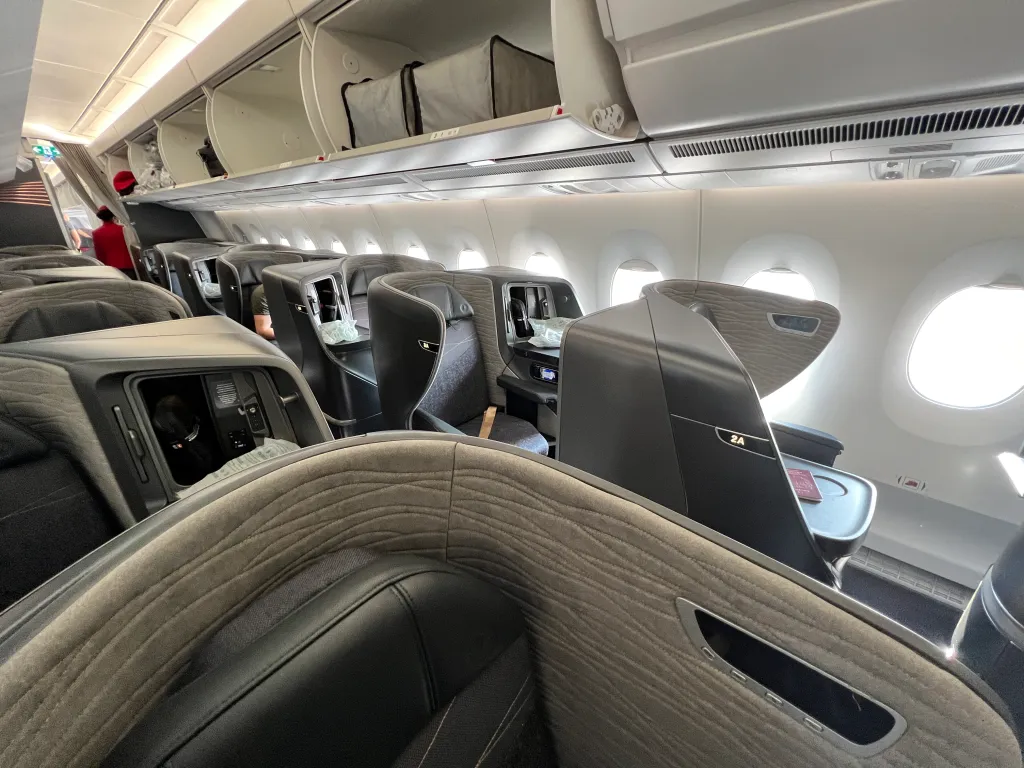
Winner: Qatar Airways. QSuites offer more privacy, more flexibility, and a more complete suite experience than anything Emirates currently flies at scale.
Dining: Generous vs. Refined
Both airlines operate a dine-on-demand service in business class, meaning you eat when you want rather than when the galley decides. But the experience on each carrier has a distinct personality.
Qatar Airways focuses on quality and presentation. The menu draws on Middle Eastern cuisine alongside international options, all plated on proper crockery with metal cutlery. The wine list is curated seasonally by sommeliers, and the service style dates, Arabic coffee, quiet attentiveness reflects genuine Gulf hospitality. Portions are generous without being excessive, and the food consistently performs well on long-haul flights.
Emirates goes bigger. The menu is broader, the Champagne (often Dom Pérignon) starts flowing at boarding, and then there’s the onboard bar. On A380 flights, the standing cocktail lounge at the rear of the upper deck is one of the most distinctive features in commercial aviation passengers gather, chat, and order cocktails mid-flight like it’s a hotel bar at 38,000 feet. If wine service and a social atmosphere matter to you, Emirates is the more indulgent choice.
Winner: Tie with conditions. Qatar wins on food quality and presentation. Emirates wins if you’re flying A380 and want the bar experience.
Airport Lounges: It’s Not Even Close
Qatar Airways’ Al Mourjan Business Lounge at Hamad International Airport in Doha is frequently ranked the best business class lounge in the world, and after spending time there it’s easy to understand why. It spans two floors, offers restaurant-quality à la carte dining, has a dedicated sleeping zone with recliner pods, fast shower suites, and a design that genuinely rivals a five-star hotel lobby. Long layover in Doha? The lounge makes it a pleasure rather than a chore.
If you have time to leave the airport entirely, Doha is worth exploring. Our complete 24-hour Doha stopover guide will show you exactly how to spend a layover in one of the Gulf’s most underrated cities.
Emirates’ business lounge at Dubai International is large, well-stocked, and functional. The food is good, the bar is excellent, and the showers are fast. But it lacks the architectural drama of Al Mourjan, and the sheer volume of passengers moving through Dubai International means the lounge can feel crowded, especially during peak hours.
That said, Dubai itself more than compensates. If you have time on either side of your flight, our ultimate Dubai stopover guide covers everything from 24 to 72 hours in the city and there’s genuinely no shortage of luxury to fill the time.
Winner: Qatar Airways. Al Mourjan is the best business lounge in the world. Emirates’ lounge is good but not in the same league.
In-Flight Service: Efficiency vs. Energy
Service quality will always vary by route and crew, but both airlines have recognizable personalities.
Qatar Airways crew are known for precision and discretion. They check in regularly without hovering, the service is polished and professional, and there’s a sense of genuine hospitality that runs through every interaction quiet, attentive, never intrusive. If you’re flying to sleep or work, the crew largely leaves you to it without making you feel ignored.
Emirates crew bring more energy. They actively encourage passengers toward the bar, engage in more conversation, and create a warmer, more social cabin atmosphere. Some travelers love this; others find it more distracting on overnight flights. Neither style is objectively better it depends entirely on what you want from a long-haul flight.
Winner: Personal preference. Qatar for quiet efficiency, Emirates for warmth and social energy.
Hubs, Networks & Stopovers
Both airlines are built around Middle Eastern mega-hubs, and both offer stopover programs that let you spend a night or two in Doha or Dubai without paying extra. This is one of the most underused tricks in long-haul travel turning a connection into a mini break.
Qatar’s network is particularly strong for Africa, South Asia, and Southeast Asia routing through Doha. If you’re continuing onward to somewhere like Singapore, the routing via Doha is seamless and Singapore itself is one of the world’s great stopover cities. Our 36-hour Singapore stopover guide will show you how to make the most of it.
Emirates’ strength is its unmatched frequency to Australia, East Africa, and North America via Dubai. Dubai International is the world’s busiest international airport for a reason the connections are simply extraordinary. If your journey takes you through Europe into the Gulf and onward east, Emirates often offers more frequency and flexibility.
If your routing takes you through Istanbul a common hub for many European originating passengers, it’s worth comparing all three airlines. Our 48-hour Istanbul stopover guide makes the case for why a Turkish Airlines connection via Istanbul is another option worth considering.
Winner: Depends on your route. Qatar for Africa and South Asia. Emirates for Australia and East Africa.
Value for Money and Points
On cash fares both airlines price similarly, typically between $3,000 and $8,000+ for long-haul business class depending on route and booking window. Emirates runs more promotional fares on competitive routes like London–Dubai–Sydney, while Qatar tends to price higher where it holds stronger network advantages.
For points redemptions, Qatar Airways is part of the OneWorld alliance, which means you can book its seats using British Airways Avios, American AAdvantage miles, or Cathay Pacific Asia Miles all of which can offer exceptional value. Emirates Skywards is a closed ecosystem with moderate redemption rates, though Alaska Airlines Mileage Plan continues to offer strong Qatar and Emirates redemption options for North American flyers.
Winner: Qatar Airways, for the flexibility and depth of OneWorld redemption options.
The Final Verdict
| Category | Winner |
|---|---|
| Business Class Seat | Qatar Airways (QSuites) |
| Dining | Tie |
| In-Flight Bar | Emirates |
| Airport Lounge | Qatar Airways |
| In-Flight Service | Tie |
| IFE Screen | Emirates |
| Points Value | Qatar Airways |
| Network Breadth | Tie |
Qatar Airways wins on the fundamentals that matter most for long-haul business class: the seat, the lounge, and the sleeping experience. If arriving rested, private, and genuinely pampered is the goal, QSuites deliver more completely than anything Emirates currently offers at scale.
Emirates wins on spectacle and social experience. The A380 upper deck, the onboard bar, the warmer crew energy, and the Dom Pérignon at boarding make it a more theatrical flight. For travelers who treat the journey itself as part of the holiday rather than something to sleep through, Emirates has its own compelling magic.
If you can only choose one: book Qatar Airways QSuites and use the Doha connection to squeeze in a stopover. If you’re flying A380 on a social trip and the bar matters, Emirates won’t disappoint you either.
The good news is that both airlines operate some of the best business class cabins on Earth. You genuinely cannot make a bad choice here.